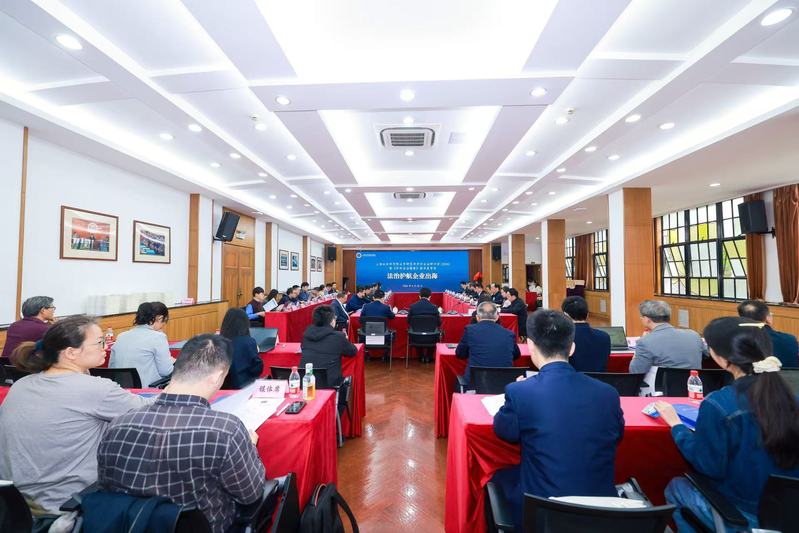
On 25 April 2026, the Institute of Law of SASS, together with the Shanghai International Business Law Research Association, hosted the Seminar on Foreign-Related Rule of Law (2026) and the launch of the book Essentials of the Foreign-Related Rule of Law. Held under the theme "The Rule of Law: Safeguarding Enterprises' Global Expansion," the event explored how the development of the foreign-related rule of law can better support high-level opening-up and provide stronger legal safeguards for Chinese enterprises going global.
Professor Quan Heng, Secretary of CPC SASS Committee and Chancellor of SASS, noted that profound restructuring of global industrial and supply chains, coupled with growing geopolitical uncertainty, has made overseas expansion not merely a strategy for market growth, but a necessity for the survival and long-term development of enterprises. As a national high-level think tank, SASS attaches great importance to research on the foreign-related rule of law. Last year, the Academy launched the research project "Development of the Foreign-Related Rule of Law during the 15th Five-Year Plan Period," focusing on the legal safeguards needed to support the development of Shanghai's "Five Centers" Initiative and addressing the key challenges and bottlenecks in advancing the foreign-related rule of law. The project has generated targeted and actionable policy recommendations, with its findings already contributing to the development of the foreign-related rule of law in Shanghai. Looking ahead, SASS will continue to deepen research in this field, while advancing area-specific legal studies, contributing its expertise to helping Chinese enterprises navigate the evolving landscape of global governance.
Mr. Zhang Lei, Executive Deputy Secretary of the Political and Legal Affairs Commission of the Shanghai Municipal Committee, commended the Institute of Law at SASS for its achievements in theoretical research, policy consultation, and international engagement in the field of the foreign-related rule of law. Drawing on the Commission’s practical experience, he emphasized that the rule of law serves not only as a "safety valve" for managing risks but also as a driving force for high-quality development in an increasingly complex international environment. He outlined four priorities for supporting Chinese enterprises going global: providing comprehensive legal support throughout the entire process of overseas expansion; strengthening the supply of foreign-related legal services, reinforcing security safeguards and implementing the two action plans; enhancing the capacity of legal services by establishing a leading center integrating international commercial litigation, arbitration and mediation; and fostering a more business-friendly, secure and supportive environment, with particular attention to addressing the challenges faced by private enterprises in going global. He added that Shanghai would continue to strengthen the development of the foreign-related rule of law to provide even stronger legal support for building a modern international metropolis with global influence.
Mr. Jia Yu, President of the Shanghai High People's Court, noted that the importance of developing the foreign-related rule of law is becoming increasingly evident, and that stronger legal safeguards are essential to support Chinese enterprises expanding overseas. He put forward three priorities. First, cutting-edge research on the foreign-related rule of law should be strengthened. By adopting a problem-oriented approach, China should develop an autonomous and innovative system of foreign-related legal rules, transitioning from a participant in international rule implementation to an active contributor to international rule-making. Second, judicial safeguards should be better aligned with national development strategies. This includes establishing a foreign-related adjudication system that supports national priorities, improving diversified dispute resolution mechanisms for foreign-related cases, and deepening international judicial cooperation and rule harmonization. Third, greater efforts should be made to cultivate high-calibre talent in the field of the foreign-related rule of law. This can be achieved by strengthening collaboration among government, industry, academia and research institutions, improving practice-oriented training mechanisms, advancing legal education reform, and building a stronger talent pool to support Chinese enterprises going global. He added that the Shanghai's courts would continue to leverage the rule of law to safeguard the steady development of Chinese enterprises and contribute to the advancement of China's foreign-related legal system.
Essentials of the Foreign-Related Rule of Law is the first academic monograph in China to provide a systematic exposition on the development of the foreign-related rule of law in the new era from the perspective of legal political theory. Grounded in the strategic context of the great rejuvenation of the Chinese nation and the profound changes unseen in a century, the book responds to the strategic demands of high-level opening-up and the development of the foreign-related rule of law. It presents a comprehensive analysis of the theoretical foundations, practical framework and future pathways for advancing the foreign-related rule of law, representing a major achievement of SASS in this important field of research.