
On 4 June 2026, the Shanghai Academy of Social Sciences (SASS) and the Friedrich Ebert Foundation (FES) jointly hosted the 11th Green Development Forum on Technology, Innovation and Sustainability in the Battery Industry. The forum brought together Chinese and German experts and scholars for in-depth discussions on technological innovation, industrial cooperation and sustainable development in the battery sector.
Professor Gan Chunhui, President of SASS, stated that there is now broad global consensus on the importance of green and low-carbon development. With the accelerated development of the energy transition, electric mobility and new energy storage industries, the battery sector has become a key pillar of the global green transition. He highlighted three priorities: Firstly, we must uphold the coordinated development of technological innovation and ecological conservation; advance technological upgrading to reduce carbon emissions; enhance product performance through eco-design; and leverage the circular economy to reduce dependence on resources, thereby promoting harmonious coexistence between humanity and nature through scientific and technological innovation. Secondly, we must strengthen cooperation on the development of rules and standards. China and Germany, as well as China and the EU, can deepen policy alignment and mutual recognition of standards, using a unified and standardized regulatory framework to reduce the costs of industrial cooperation and set an example for global green industrial cooperation. Thirdly, we must work together to strengthen the resilience and security of industrial and supply chains. Both sides should uphold the principles of openness and inclusiveness, deepening collaboration in areas such as technological research and development, resource recycling and supply chain management, to achieve complementary strengths and mutual benefit, and jointly safeguard the stability and smooth operation of global industrial and supply chains.
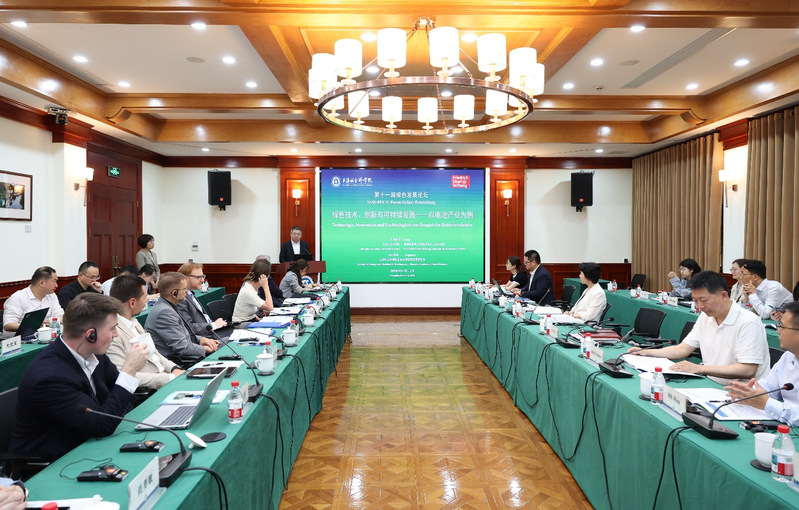
Benjamin Reichenbach, Chief Representative of the FES Shanghai Representative Office, pointed out that economic and technical cooperation between China and Germany has long been a cornerstone of bilateral relations, with particularly close collaboration in the battery sector. At present, green technology is a vital pillar for China’s carbon neutrality and high-quality economic development, and the battery industry plays a pivotal role in advancing the green transition. Technical cooperation and commercial exchanges between China and Germany, as well as between China and the EU, are progressing steadily throughout the battery value chain, and future collaboration is expected to expand into areas such as climate change, the digital economy and global governance. He mentioned that industrial cooperation is shaped by a range of factors, including regulatory frameworks and industrial policies, and expressed his hope that experts from both countries would engage in thorough discussions and build consensus on issues such as the regulatory framework for the battery industry, standard-setting and the development of sustainable supply chains.
Participants engaged in lively discussions on topics including the environmental and climatic impacts of battery technology; battery industry regulation and standards in China and the EU; opportunities and challenges for Sino-German cooperation on sustainable supply chains; the circular economy system for batteries; and cooperation in the battery industry and strategic interests. The discussions generated valuable insights into developing a green battery supply chain ecosystem between China and the EU, enhancing the reliable sharing of information on carbon footprints and raw material sourcing, advancing joint technological research and development, strengthening talent cultivation, and promoting the sustainable development of the global battery industry.

