
On 16 January 2026, the International Symposium Celebrating the Publication of the Chinese Translation of Christopher Columbus’s Annotations on The Travels of Marco Polo (hereinafter “the Annotated Translation”) was held at SASS. The volume was jointly published in Macao by the Institute of History at SASS, the Research Center for the History and Culture of Hong Kong and Macao of Jinan University, and University of Cádiz, Spain. The symposium brought together experts for in-depth discussions on this text, with a view to exploring its scholarly value and advancing research on the history of cultural exchanges between China and the West.
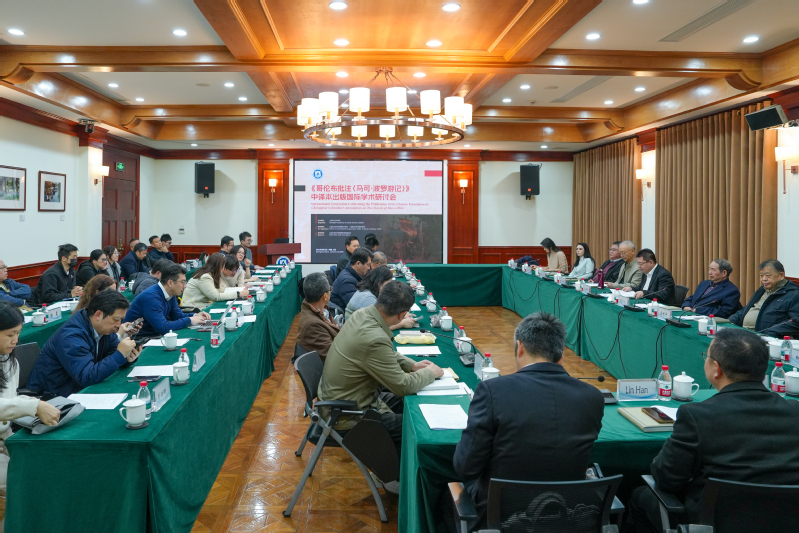
At the opening ceremony, Professor Gan Chunhui, Executive Vice President of SASS, emphasized that the text’s significance lies in its connection between Marco Polo and Christopher Columbus, two figures who reshaped global perceptions of the world. Marco Polo’s travelogue ignited Western imaginations of the East, while Columbus’s voyages accelerated the Age of Discovery and early processes of globalization. At a time when mutual learning and dialogue among civilizations are increasingly vital, rigorous study of this work can deepen understanding of both Eastern and Western historical contexts, while offering valuable perspectives for advancing area studies and promoting more equitable intercultural dialogue. Ye Bin, Deputy Director of the Institute of History at SASS, noted that the publication of the Annotated Translation both continues and enriches the Institute’s tradition of historical scholarship, and will contribute to further research on the history of Sino-Western cultural exchange in China. Professor Ye Nong, Dean of the Research Center for the History and Culture of Hong Kong and Macao of Jinan University, highlighted the efforts and challenges involved in producing this “three-in-one” edition, which presents the original Latin text alongside Spanish and Chinese translations.
The symposium featured comprehensive discussions on the background, textual transmission, and significance of the Annotated Translation, as well as on broader themes such as global history, area studies, and future research directions. These exchanges underscored the important role of Chinese history and culture in facilitating cross-cultural dialogue and shaping global knowledge. The publication of the Annotated Translation is expected to further strengthen international academic cooperation, promote interdisciplinary research, and advance cross-cultural exchange between China and the wider world.

