
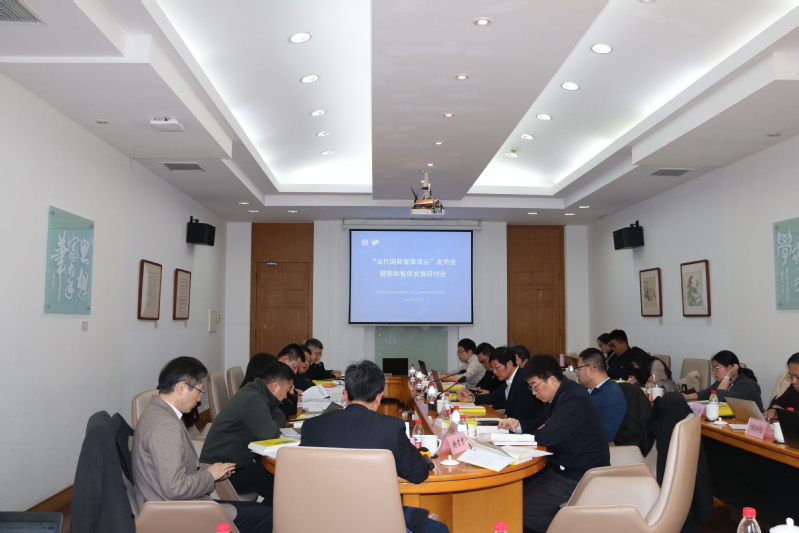
On 15 January 2026, the launch ceremony for the Contemporary International Think Tanks Translation Series and symposium on the development of international think tanks was held. At the event, two newly published translations from the series were unveiled: Handbook on Think Tanks in Public Policy and Think Tanks, Governance and Development in Africa.
Professor Gan Chunhui, Executive Vice President of SASS, expressed his sincere gratitude to the translators and experts for their support of the series. He noted that future efforts should focus on better serving national rejuvenation and the building of a strong nation, whilst enhancing think tanks’ capacity to participate in global agenda-setting, shape international discourse, and conduct transnational collaborative research. He stressed the importance of systematically analyzing the operational mechanisms and development pathways of think tanks across different regions and institutional types, distilling both the common patterns and distinctive models of global think tank achievements, and further amplifying the international visibility of China’s outstanding think tank achievements. He also emphasized the need to accelerate the cultivation of a cohort of think tank professionals with an international outlook, a strong understanding of global rules, and the ability to engage in international dialogue, thereby providing sustained intellectual support for building a community with a shared future for mankind.
In his concluding remarks, Hou Yonggang, Vice President of SASS, stated that the experts’ insightful views would help advance the think tank translation series, deepen understanding of think tanks, and support the more effective development of think tank research. He noted that think tanks should establish long-term and systematic tracking and research on policy developments, dynamically adjust their service mechanisms, and align with work more closely with policy decision-making processes so that research outcomes can be translated into concrete policy options. He also stressed the importance of accurately grasping the ongoing technological revolution, industrial transformation and shifts in research paradigms, while taking into account the increasingly complex scenarios among political, economic, cultural and security factors. In this context, think tanks should organize structured research that is interdisciplinary, cross-sectoral and multi-perspective, while strengthening their international outlook and strategic thinking in order to boost the global competitiveness and influence of China’s think tanks.
At the symposium, participants engaged in in-depth discussions on the translated works, addressing topics such as innovation in think tank management, organized research paradigms, mechanisms for two-way translation exchange, and pathways for intelligent transformation. Participants also explored ways for think tanks to better serve national strategies while enhancing their global influence.

