
On 2 December 2025, the International Conference on Building a Globally Shared and Leading Education Museum was held at Shanghai Academy of Social Sciences (SASS), jointly organized by SASS, the Shanghai Education Development Foundation (SEDF), and the SASS Think Tank Foundation.
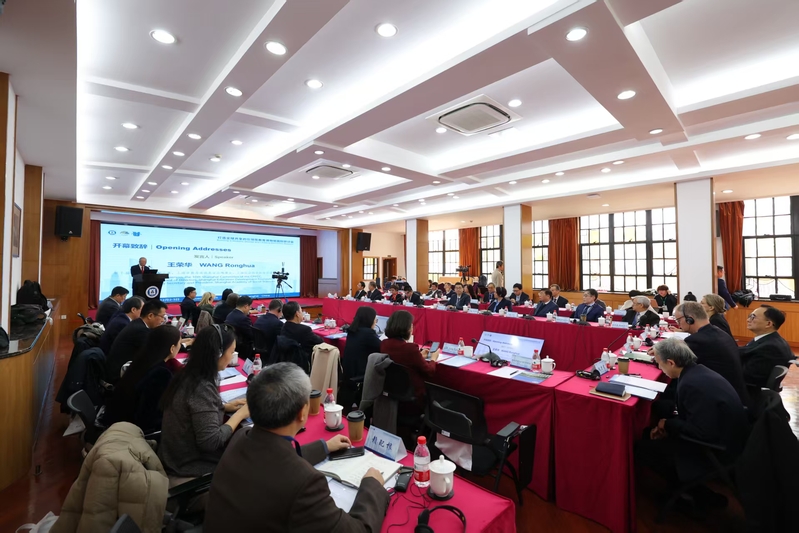
The conference focused on the establishment of a globally shared, pioneering education museum in Shanghai. Bring together experts from China and abroad, discussions addressed the Shanghai perspective and its international significance, as well as issues related to the construction, operation, collaborative development of the proposed museum, and international best practices. Through case studies and policy-oriented exchanges, the conference contributed to refining the preparatory research for the Shanghai Education Museum and advancing the project’s practical implementation.
Professor Wu Weishan, Deputy Secretary-General of the National Committee of the Chinese People’s Political Consultative Conference, Vice Chairman of the Central Committee of the China Democratic League, and former Curator of the National Art Museum of China, sent a handwritten letter of congratulation to the conference. He noted that establishing a comprehensive education museum in Shanghai carries profound significance. As both a repository of historical memory and a platform for public education, such a museum plays an irreplaceable role in nurturing talent for the present and future. With broad societal support, this initiative will become a major undertaking of lasting benefit to the nation and its people. He expressed confidence that the conference would pool the collective wisdom of experts from around the world and further promote the development of a high-caliber education museum.
Wang Ronghua, Chairman and Board of Directors of SEDF, emphasized that the Foundation is actively exploring a Chinese path toward modern educational philanthropy. In conjunction with its 30th anniversary, SEDF established the Shanghai Educational Museum Preparatory Research Task Force to advance the creation of an educational museum that reflects contemporary characteristics, Chinese features, and Shanghai’s unique identity, thereby contributing to the development of first-class education and a first-class city. He observed that, as a major educational hub, Shanghai represents a microcosm of modern and contemporary Chinese education, stands at the forefront of China’s educational reform and opening-up, and serves as an important global window for understanding China’s education system. Education museums, he noted, fulfill the function of “education about education”. Establishing a globally shared, development-leading education museum in Shanghai constitutes a concrete step toward building a best-practice site for Xi Jinping Thought on Culture and toward strengthening Shanghai’s role as a globally influential education center. He further remarked that over the course of its long history, China has accumulated profound educational philosophies and forged an enduring and brilliant civilization. This invaluable heritage provides strong intellectual and cultural support for accelerating the modernization of education with Chinese characteristics and for building China into an education powerhouse. SEDF, he affirmed, stands ready to contribute funding, expertise and sustained effort to expedite the establishment of the Shanghai Education Museum, and to shoulder its due responsibilities in this endeavor—one that delivers benefits for the present, yields lasting value for future generations, and calls for a sense of urgency and resolute action.
Professor Gan Chunhui, Executive Vice President of SASS, highlighted that education forms the bedrock of national rejuvenation and the cornerstone of civilizational continuity. The Shanghai Education Museum would not only showcase the city’s spirit and enhance its cultural soft power, but also serve as an important component of the national strategy to build China into an education powerhouse and to preserve valuable educational heritage. He stated that SASS would take this conference as an opportunity to deepen exchanges and cooperation with experts, scholars, universities, and primary and secondary schools worldwide, and to jointly promote research on education and education museums, thereby supporting the sustainable development of education.
Gu Hongliang, Deputy Party Secretary of CPC Shanghai Municipal Education and Health Committee, emphasized that establishing a globally accessible, development-leading educational museum holds far-reaching significance. He described the initiative as an innovative response by Shanghai’s education system to contemporary demands and global challenges. He noted that the Municipal Education Commission had entrusted SEDF with in-depth research on site selection, functional design, construction models, exhibition innovation, funding mechanisms, institutional safeguards, and operational management. This research has yielded a comprehensive and detailed plan, providing both theoretical grounding and practical support for decision-making related to the museum’s establishment. He expressed the hope that participants would offer broader and more in-depth insights to further inform Shanghai’s preparations and ensure that the future Shanghai Education Museum becomes a truly globally shared institution.
Participants from China and abroad expressed strong support for and high expectations of the Shanghai Education Museum. They proposed that it be positioned as “a globally shared, pioneering education museum” that draws upon international experience while serving as a platform for global participation and shared outcomes. Conceptually, the museum should integrate collection, participation and exploration, looking back at education’s past, showcasing its present, and placing greater emphasis on exploring its future. Functionally, it should be “a comprehensive, pivotal and landmark museum”, aligning with Shanghai’s goal of building a modern international metropolis with global influence and responsive to society’s keen expectations for an education museum.


