
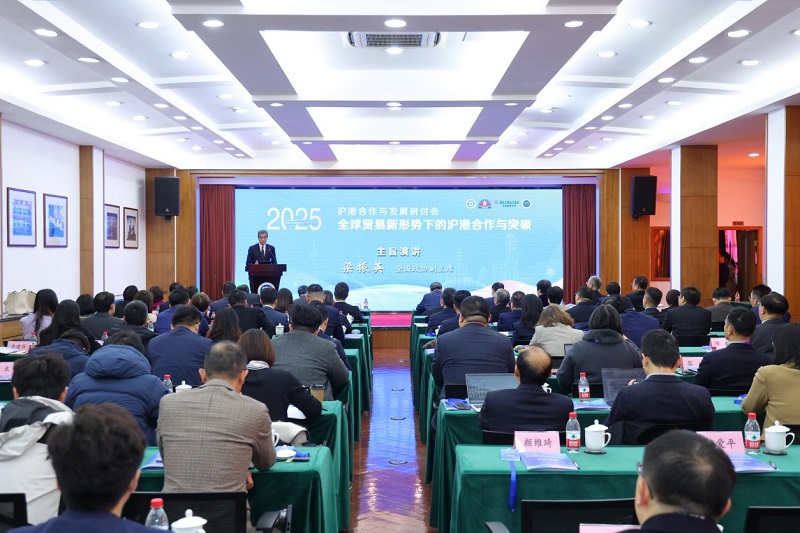
On 18 November 2025, the Shanghai-Hong Kong Cooperation and Development Conference, themed “Shanghai–Hong Kong Cooperation and New Pathways under the New Global Trade Landscape”, was convened at SASS. Keynote speakers included Mr. Leung Chun-ying, Vice Chairperson of the Chinese People’s Political Consultative Conference; Professor Fan Gang, Chief Expert at China Development Institute; Professor Zhang Daogen, former President of SASS; and Mr. Leng Weiqing, Chairman of Shanghai Industrial Holdings Limited. The conference opened with remarks by Professor Quan Heng, Deputy Director of the Publicity Department of CPC Shanghai Municipal Committee and Secretary of the CPC Committee of SASS, and Mr. Ronnie C Chan, Chairman of the Executive Committee of The Better Hong Kong Foundation.
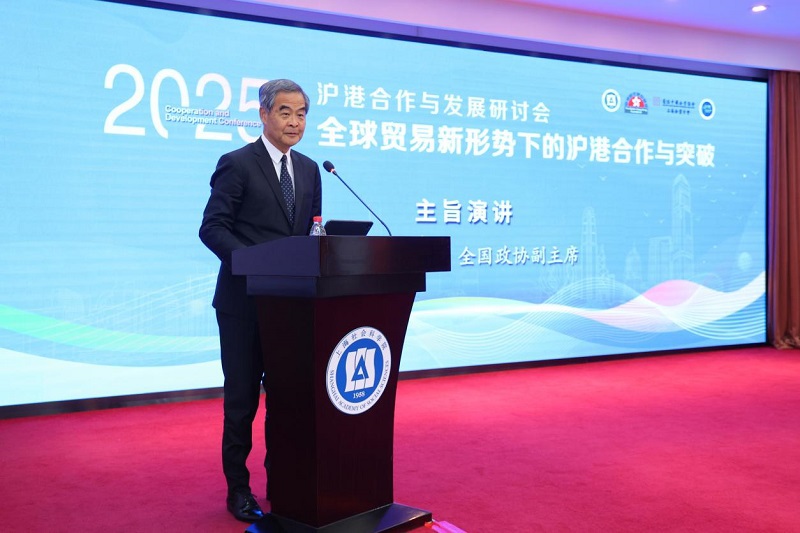
Mr. Leung remarked that successive national Five-Year Plans have consistently supported Hong Kong in consolidating and enhancing its role as an international financial, shipping and trading center, with a strategic focus on moving toward higher value-added segments of the supply chain rather than simple expansion in scale. As the world’s eighth-largest trading hub, Hong Kong enjoys distinct institutional advantages, particularly in services trade and the rule of law. However, information barriers have to some extent constrained the its functional capabilities and regional collaboration efficiency. Under the framework of “One Country, Two Systems”, Shanghai and Hong Kong should leverage their institutional complementarities, better align supply with demand, and address information asymmetries. Deepened cooperation in areas such as commodity supply chains and the international expansion of Chinese enterprises will support high-quality trade development and high-level opening-up.
Professor Quan thanked Vice Chairperson Leung and the Foundation for their long-standing support of SASS. He noted that the global trade landscape is undergoing profound restructuring, during which Hong Kong’s offshore advantages and Shanghai’s onshore foundations form a natural synergy. Against the backdrop of global transformation, enhanced strategic coordination between the two cities is essential to better serve China’s broader agenda of high-level opening-up.
Professor Zhang observed that capital “going global” has become a defining trend among major economies. Shanghai is accelerating the development of the Hongqiao International Open Hub, building a cluster of services to support enterprises in expanding overseas. As a world-class international financial center and global super-connector, Hong Kong can complement Shanghai through its offshore strengths. By establishing interconnected platforms, deepening cooperation in financial and professional services, strengthening talent systems, and promoting dual-headquarter models, Shanghai and Hong Kong can jointly support Chinese enterprises in achieving steady and sustainable overseas investments.
Mr. Chan expressed optimism regarding the investment environment in the Asia-Pacific region over the next five to ten years. While China’s service sector presents substantial development potential, he stressed the need for deeper research into optimizing economic structures and corporate governance. Such efforts would enable Chinese enterprises to expand abroad more effectively while enhancing China’s international image, with Shanghai-Hong Kong cooperation playing a crucial role in this process.
Professor Fan noted that despite challenges posed by unilateralism, most nations remain committed to the existing international rules governing trade and investment. China continues expanding its openness, with future trade and investment flows expected to exceed historical levels. Structural advantages, including a large pool of highly educated talent and abundant clean energy resources, provide strong momentum and development space. He added that moderate “fraternal competition” between Shanghai and Hong Kong could foster joint exploration and mutual benefit, ultimately better serving national development.
Mr. Leng highlighted the role of Shanghai-based enterprises operating in Hong Kong in advancing strategic collaboration, talent exchange, and people-to-people connectivity. These initiatives, he noted, help integrate the respective strengths of Shanghai and Hong Kong, contributing to a more interconnected development framework in support of national progress.
During the parallel sessions, 13 entrepreneurs, experts and heads of industry organizations from Shanghai and Hong Kong engaged in focused discussions on “Challenges in Chinese Enterprises Going Global and Integrating Domestic and International Trade” and “Optimizing Commodity Supply Chain Ecosystems and Service Capabilities”, sharing practical insights and experiences.

