
On 7 November 2025, the China-LAC Think Tank Forum on Economic and Trade Cooperation was held at SASS. More than seventy experts and entrepreneurs from China and Latin American countries—including Mexico, Argentina, Peru, Chile, Ecuador, Uruguay, Bolivia—attended the forum.
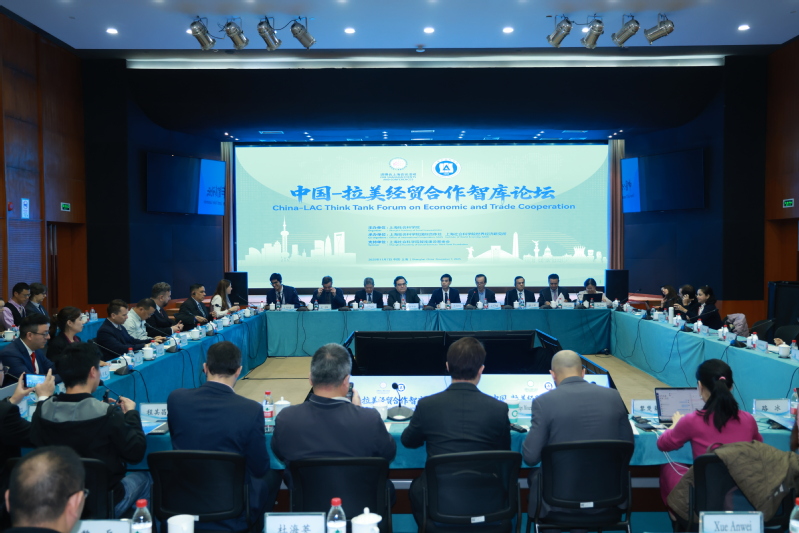
In his opening remark, Vice President Wu Xueming noted that while the world is currently confronting challenges such as unilateralism and protectionism, China and Latin American countries remain committed to multilateralism and have achieved significant progress through pragmatic cooperation. In 2024, China-Latin America trade reached US$518.47 billion, while China’s cumulative investment in the region exceeding US$600 billion, generating substantial local employment. At the same time, the partnership faces practical challenges, including long geographical distances, weak infrastructure, the digital divide, and geopolitical complexities. He highlighted that the Recommendations of the Central Committee of the Communist Party of China for Formulating the 15th Five-Year Plan for National Economic and Social Development, adopted at the Fourth Plenary Session of the 20th Central Committee of the Communist Party of China, provides a roadmap for advancing modernization with Chinese characteristics while injecting robust momentum and stability into China-Latin America economic and trade cooperation. As a leading academic research institution and a nationally recognized think tank, SASS stands ready to take this forum as a starting point to bring together the wisdom and dynamism of governments, think tanks and enterprises, explore new avenues of cooperation, and jointly contribute to building a China-Latin America community with a shared future.
Claudio Rojas Rachel, former Ambassador of Chile in Guyana and the Republic of the Philippines, pointed out that China-Latin America relations have deep foundations and stable economic and trade ties. The Belt and Road Initiative provides a crucial framework and opportunities for infrastructure development and financing cooperation between the two sides. He emphasized that this forum serves as a timely platform for knowledge exchange, helping cultivate collaborative talent through sustained knowledge sharing, mutual learning, and deeper understanding. Looking ahead, China and Latin America should expand cooperation beyond traditional trade, strengthen people-to-people exchanges and youth development, and translate the insights gained from this forum into sustained joint action. This will enable both sides to address shared development challenges and work together towards building a fairer, more prosperous future.
Participants reached a broad consensus on China-Latin America economic and trade cooperation. First, the prospects for cooperation are expansive, and both sides should jointly seize the opportunities. China-Latin America relations are at their strongest point in history, with the Belt and Road Initiative serving as a key platform. Second, priority areas for collaboration in Latin America are clear and require pragmatic advancement. There is significant potential in upgrading trade and investment quality, promoting infrastructure and green transition, and strengthening scientific innovation and digital cooperation. Third, both sides must join hands to overcome challenges and deepen soft connectivity. Practical progress should be achieved through strengthening bilateral dialogue mechanisms, enhancing localization and cultural adaptation, fostering people-to-people ties, and promoting sustainable development. Both sides should refine synergistic mechanisms in trade, investment, innovation, and cultural exchange, and jointly build a more resilient and mutually beneficial China-Latin America community with a shared future.

