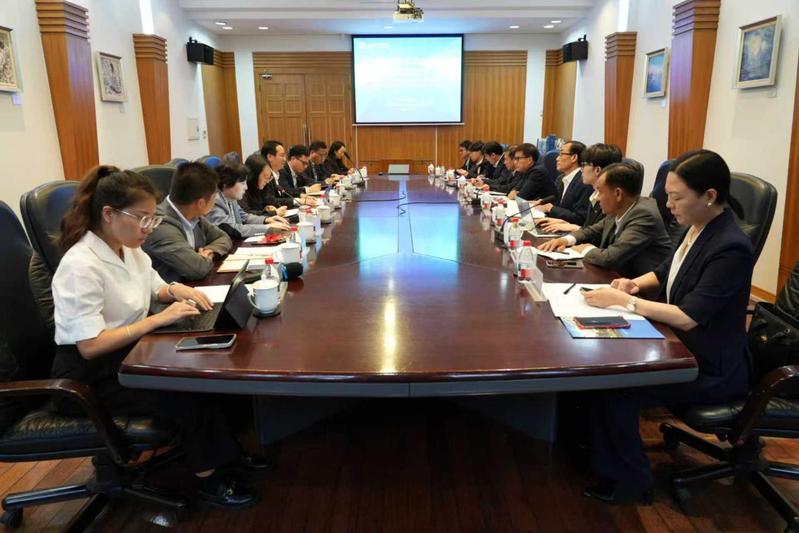
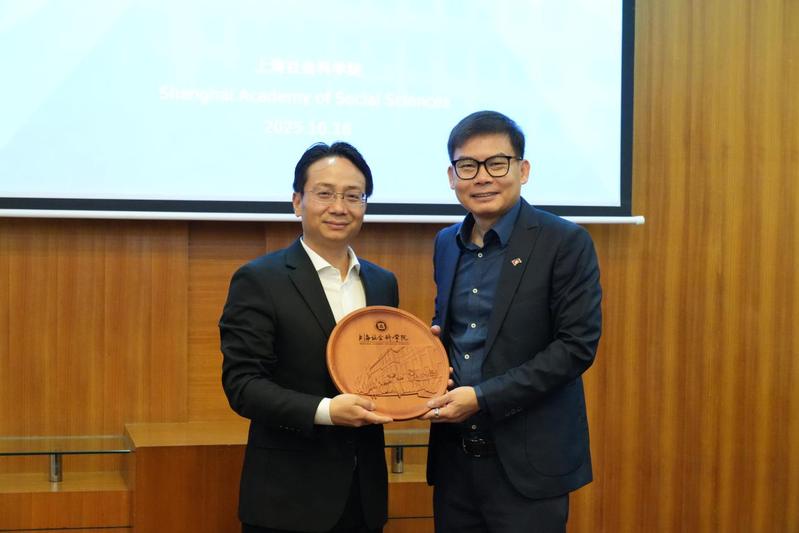
On 16 October 2025, Deputy Secretary-General and Chairman of Advisory Council of the National Assembly of Cambodia, H. E. Dr. Chheang Vannarith, led a delegation to visit SASS. Professor Yao Jianlong, Deputy Secretary of the CPC SASS Committee, met with the delegation, and the two sides discussed the concept of whole-process people’s democracy.
Professor Yao briefed the delegation on SASS’s historical development, institutional overview and recent advancements in policy consultation, academic research, and talent cultivation. He highlighted the academy’s research on whole-process people’s democracy, including its longitudinal study of the Hongqiao Legislative Outreach Office—a model of legislative practice under this framework—and the operations of the Shanghai Research Base for Whole-Process People’s Democracy established at SASS.
H. E. Dr. Chheang Vannarith noted that last year saw active exchanges between the National Assembly of Cambodia and Chinese National People’s Congress and National Committee of the China People’s Political Consultative Conference, with Cambodia paying close attention to China’s concept of whole-process people's democracy. He emphasized that Shanghai, as the birthplace of the Communist Party of China, is also where this concept was first proposed. During this visit, Cambodia hopes to strengthen exchange and research on this concept with SASS, laying the groundwork for future collaboration.
During the discussion, Professor Chen Xiangqin, Deputy Director of the Institute of Chinese Marxism Studies at SASS, outlined the fundamental principles of whole-process people’s democracy, while Professor Wang Haifeng from the Institute of Law, Associate Professor Ma Liya from the Institute of Chinese Marxism Studies, Associate Professor Xue Zelin and Assistant Professor Lin Jiayi from the Institute of Politics and Public Administration, shared their specialized insights on the role of legislative bodies within this framework, drawing upon their respective research.